DENTAL IMPLANTS IN ANTALYA
Dental implants can support a crown, bridge or denture when replacing one or more missing teeth. The plan begins with the teeth, gums, bone, bite, general health and the restoration you will use every day.
Treatment suitability and final planning are confirmed only after the appropriate clinical assessment.
Implants may support a single crown, a bridge, an overdenture or a fixed full-arch restoration in selected cases.
Healthy tissues, available bone, neighbouring anatomy and controllable risk factors are considered before surgery.
The intended crown, bridge or denture guides implant position, spacing, bite, appearance and cleaning access.
WHAT IS A DENTAL IMPLANT?
A dental implant is a root-form fixture placed surgically in the jawbone. After the required biological and clinical conditions are achieved, it can support an abutment and a crown, bridge or removable prosthesis.
The visible tooth is the restoration, not the implant itself. Implant position must therefore be planned from the final tooth position, bite, tissue contours, material, hygiene access and future repair needs.
WHO MAY BE CONSIDERED?
Assessment may be appropriate for an adult with one or more missing teeth when the mouth and general health can support surgery, healing and long-term maintenance.
Active gum disease, decay, infection, smoking, poorly controlled health conditions, medicines, grinding, limited bone or soft tissue, neighbouring anatomy and the ability to clean the restoration may change timing, risk or the recommended alternative. Bone or soft-tissue augmentation may be discussed when required.
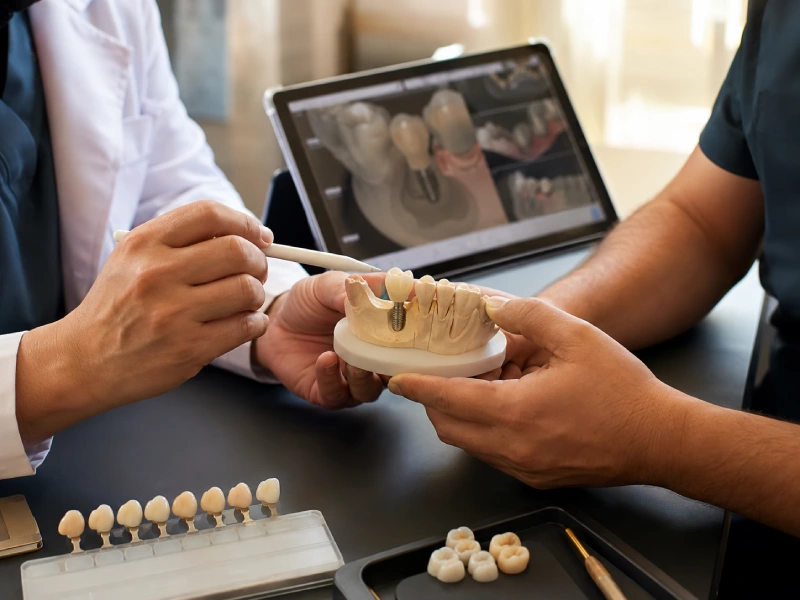
Illustrative image: implant position, component selection and restoration design are confirmed from the patient’s own examination and records.
ASSESSMENT & PROCESS
The sequence varies with the missing tooth, extraction timing, infection, bone and gum needs, implant stability, healing and the selected restoration.
Discuss the missing tooth or teeth, symptoms, previous treatment, health history, smoking, medicines and priorities.
The team examines teeth, gums, bite, restorative space and site health and decides which photographs and imaging are appropriate.
Two- or three-dimensional imaging is used where indicated to assess bone and neighbouring anatomy and to coordinate the planned restoration.
Decay, gum disease or infection should be managed. Extraction, bone or soft-tissue procedures may be staged or combined when clinically appropriate.
The implant is placed according to the confirmed plan. Immediate placement or an interim tooth is not automatic and depends on site and stability criteria.
After the required healing and checks, the crown, bridge or denture is completed and an individual hygiene and professional-care schedule begins.
DENTAL IMPLANT PATHWAYS
These are treatment categories, not fixed packages. Implant number, distribution, components and restoration design are confirmed after assessment.
One implant may support one crown when the site, neighbouring teeth, bite and tissue conditions are appropriate.
Two or more implants may support a bridge replacing several teeth without requiring one implant for every missing tooth.
Implants may improve the retention of a removable denture while preserving removability for cleaning and maintenance.
A complete-arch fixed restoration supported by four appropriately distributed implants in selected cases.
A six-implant complete-arch foundation considered when anatomy and the restorative plan support this configuration.
Zygomatic implants may be considered when severe upper-jaw bone deficiency limits conventional implant sites.
IMPLANT OR ALTERNATIVE?
The condition of neighbouring teeth, bone and gums, treatment burden, maintenance, preferences and the consequences of future complications should guide the choice.
A single implant can replace one tooth without preparing sound neighbouring teeth; implants can also support bridges or dentures.
Surgery, healing, hygiene, professional monitoring and possible biological or technical maintenance remain part of the treatment.
No treatment or monitoring, a tooth-supported bridge, a removable denture or orthodontic space management in selected situations.
These options avoid implant surgery but may involve neighbouring teeth, removable components, different function or different maintenance needs.
Clinical note: A maintainable natural tooth should not be removed simply to create an implant treatment plan.
POTENTIAL BENEFITS
Implants can support different restorative designs, but the implant, surrounding tissues and prosthetic components all require monitoring.
May replace a missing tooth without preparing suitable neighbouring teeth.
Can support a restoration replacing several teeth with a planned number and distribution of implants.
Can improve retention and stability for selected removable prostheses.
Fixed or removable designs, materials and component strategies are selected for the individual case.
SURGICAL & BIOLOGICAL RISKS
TECHNICAL CARE & WARNING SIGNS
REAL DENTAL IMPLANT RESULTS
Show consented Dr. Smile Antalya cases only after the starting condition, treated sites, implant and restoration type, accompanying procedures, complications and maintenance plan have been clinically verified.

Individual results vary. Images must have documented patient consent, and treatment descriptions must be clinically verified before publication.
INTERNATIONAL PATIENT SEQUENCE
Photographs and existing records can organise an initial conversation. They cannot confirm implant suitability, bone procedures, loading, healing or the final number of visits.
Explain the missing tooth or teeth and receive secure guidance on relevant records; do not send sensitive health information through the enquiry form.
Examination and appropriate imaging confirm site health, bone and gum needs, alternatives and the restorative plan.
Extraction, implant placement, augmentation and an interim tooth are sequenced according to the confirmed clinical conditions.
Healing checks, final prosthetic stages and maintenance are coordinated, including when support from a local dentist is required.
FREQUENTLY ASKED QUESTIONS
These answers are general information. The treating team must explain what applies to your missing tooth, health, anatomy and restorative options.
The implant is placed in the bone. An abutment connects it to the visible crown, bridge or removable prosthesis. Component design varies by case.
An adult with missing teeth may be assessed when oral and general health, tissues, anatomy, risk factors and long-term cleaning can support the plan. Suitability is not confirmed online.
Sometimes, but immediate placement requires favourable site and patient conditions. Infection, bone walls, tissue, implant stability and the restoration plan guide timing.
Not everyone does. Available bone, implant position and the planned restoration determine whether no graft, a small site procedure or a staged augmentation is discussed.
Not automatically. Immediate or early loading depends on implant stability, site conditions, bite and the type of restoration. A different provisional option may be recommended.
There is no fixed duration. Extraction healing, disease control, augmentation, implant stability, tissue healing and laboratory stages all affect the sequence.
There is no guaranteed lifespan. Health, smoking, history of gum disease, hygiene, bite, materials, component wear and professional maintenance all influence outcomes.
No. Each option has different surgical, biological, tooth-preparation, comfort, maintenance and repair considerations. The suitable choice depends on the individual situation.
Yes. Peri-implant mucositis affects the soft tissues and can progress to peri-implantitis with supporting bone loss. Prevention and early assessment are important.
Brush effectively, clean around and beneath the restoration with recommended tools, avoid smoking and attend an individual professional-care schedule. Report bleeding, swelling or looseness promptly.
ASK ABOUT DENTAL IMPLANTS
Tell us which tooth or teeth are missing, whether you have symptoms and what you would like to understand. Our patient coordination team will explain which records may be useful for an initial review.
WhatsApp: +90 545 213 09 59
Clinic: +90 545 213 09 09
Email: info@drsmileantalya.com
Fields marked as required must be completed.