LAMINATE VENEERS IN ANTALYA
A laminate veneer covers selected visible tooth surfaces to change form, colour or proportion. The design, material and preparation must follow oral health, enamel, tooth position, existing restorations and bite — not a standard smile package.
Treatment suitability and final planning are confirmed only after the appropriate clinical assessment.
A veneer is bonded mainly to the facial surface and may include the incisal edge when the design requires it.
Available enamel is an important part of adhesive planning; preparation follows tooth position, material and the intended change.
Feldspathic porcelain, glass-ceramic or composite may be considered; “laminate” describes the restoration concept rather than one brand.
RESTORATION DESIGN, NOT A SINGLE MATERIAL
A laminate veneer is a restoration bonded to selected visible surfaces of a tooth. Ceramic laminate veneers may be made from feldspathic porcelain, leucite-reinforced glass-ceramic or lithium disilicate. Direct and indirect composite veneers also exist and have different maintenance and repair characteristics.
The word “laminate” does not confirm the ceramic, thickness, preparation design or suitability. These decisions depend on the underlying tooth and the change being planned.
ASSESSMENT BEFORE AESTHETICS
Clinical note: A healthy or maintainable tooth should not receive a veneer when monitoring, whitening, orthodontics, polishing or a repair better fits the need.
ASSESSMENT & PROCESS
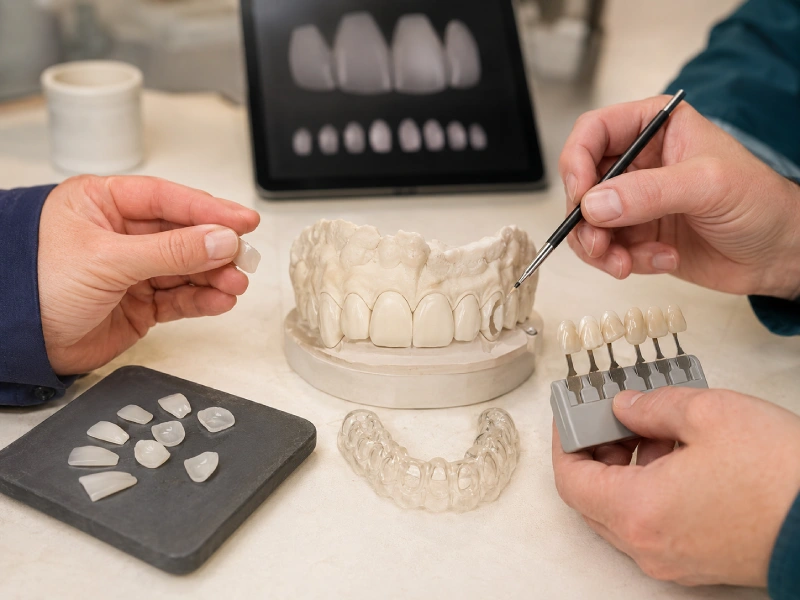
The visible change is designed before the tooth is prepared. Photographs, records and a preview or mock-up can help assess proportion, edge position, speech and the space available for ceramic or composite.
Preparation is case-specific: a no-preparation approach suits only selected tooth positions and additions. If tooth structure is removed, that change is irreversible.
Teeth, gums, symptoms, cracks, existing restorations, tooth position and functional contacts are assessed.
Photographs, records and a mock-up or digital preview can guide proportions, edge position and communication.
Ceramic or composite and the required preparation are selected according to substrate, space, shade and function.
Digital or conventional impressions are made; temporary protection is used when preparation or the case requires it.
Fit, form, surface texture, opacity, translucency and shade are evaluated before final bonding.
Tooth and restoration surfaces are conditioned, the veneer is bonded and margins, bite and maintenance are reviewed.
WHAT MAY BE POSSIBLE
Laminate veneers may change selected visible aspects of a tooth, but they do not treat active disease, rebuild every structurally compromised tooth or replace orthodontic movement when position is the main problem.
Selected teeth may be refined in width, length, contour and surface texture within the restorative space available.
Material, thickness, opacity, translucency, cement and underlying tooth colour work together; some substrates limit the achievable change.
A veneer may restore selected facial or incisal defects when remaining structure and bite support the design.
Small spacing or proportion differences may sometimes be masked, but orthodontics may be safer for larger positional corrections.
WHEN A LAMINATE VENEER MAY NOT FIT
Active decay or gum disease, insufficient enamel, extensive restorations, major fractures, uncontrolled grinding, severe wear, unfavourable bite relationships or a tooth requiring structural coverage may lead to disease control, orthodontics, composite repair, an onlay/crown or another plan.
MATERIAL OR ALTERNATIVE?
No material is automatically best. Enamel, preparation, shade change, required thickness, bite, laboratory technique, repair expectations and patient priorities guide the choice.
Layered porcelain can offer detailed optical character in selected cases. It requires careful substrate, thickness, laboratory and adhesive planning.
A glass-ceramic route with different strength and optical characteristics. “E-Max” identifies a material system, not every laminate veneer.
Resin may preserve more tooth tissue and can be easier to repair, but surface gloss, staining, wear and maintenance differ from ceramic.
A crown surrounds the tooth and generally involves broader preparation. It may be considered when structural coverage is required, not simply as a cosmetic upgrade.
POTENTIAL ADVANTAGES
Selected laminate veneer designs may conserve more tooth tissue than full-coverage restorations while allowing controlled surface form and optical character. The outcome still depends on diagnosis, substrate, preparation, material, fabrication and bonding.
Selected veneer preparations can be limited to visible surfaces, but the amount depends on tooth position and the required change.
Width, length, contour, edge form and surface texture can be planned before the final restoration is made.
Material, thickness, surface and cement can be coordinated with the underlying tooth and neighbouring teeth.
Ceramic and composite have different polishing, repair and replacement considerations that can be discussed before treatment.
LIMITATIONS & RISKS
CARE & LONGEVITY
There is no fixed or guaranteed lifespan. Remaining enamel, material, preparation, bonding, tooth health, bite, grinding, trauma, hygiene, maintenance and repairability all influence service time.
Clean effectively, avoid using restored edges to bite hard objects and follow the individual review schedule. Report sensitivity, roughness, movement, chipping, gum change or bite change.
REAL LAMINATE VENEER RESULTS
Show consented Dr. Smile Antalya cases only after the starting condition, treated teeth, preparation, remaining enamel, veneer material, fabrication route, shade strategy, bite considerations, complications and follow-up have been clinically verified.

Individual results vary. Images must have documented patient consent, and treatment descriptions must be clinically verified before publication.
INTERNATIONAL PATIENT SEQUENCE
Photographs can organise an initial discussion. They cannot confirm disease, cracks, enamel, dentine exposure, bite, preparation, material, provisional needs or the final number and spacing of appointments.
Explain the teeth and changes you are considering; the team will advise which non-sensitive records may be useful.
Examination confirms oral health, enamel, old restorations, bite, tooth position and whether another treatment should come first.
Preview, material, preparation, records, provisional care and laboratory work are sequenced according to the confirmed plan.
Fit, shade, contours and bite are evaluated before bonding, with review and local maintenance guidance arranged.
FREQUENTLY ASKED QUESTIONS
These answers are general information. The treating dentist must explain what applies to your teeth, enamel, bite, material, preparation and alternatives.
It is a thin restoration bonded mainly to selected visible surfaces of a tooth. “Laminate” describes the restoration design; ceramic or composite and the exact preparation are separate decisions.
Not necessarily. E-Max commonly refers to a lithium disilicate material system, while a laminate veneer may be made from different ceramics or composite.
Selected people with healthy or stabilised teeth and gums, adequate adhesive substrate, manageable bite forces and a defined restorative or aesthetic need may be assessed. Suitability cannot be confirmed online.
No. No-preparation or limited-preparation treatment may suit selected tooth positions, but preparation is often required to create space, preserve contours and support the chosen material.
If enamel or tooth structure is prepared, the change is irreversible. Even a no-preparation veneer remains a bonded restoration that needs maintenance and may require future repair or replacement.
Only limited visual changes may be appropriate. Orthodontics may preserve more tooth structure and provide a safer positional correction for larger alignment or spacing problems.
Ceramic and existing composite do not whiten like natural teeth. If whitening is appropriate, it is generally planned before final shade selection and veneer treatment.
There is no fixed or guaranteed lifespan. Material, enamel, preparation, bonding, tooth health, design, bite, grinding, trauma, hygiene and maintenance influence service time.
Yes. Ceramic may chip, fracture or debond; composite may also stain, lose gloss or wear. Margins, gums and underlying teeth still need review.
There is no universal schedule. Examination, disease control, preview, preparation, material choice, fabrication, provisional care, try-in, bonding and review determine the sequence.
ASK ABOUT LAMINATE VENEERS
Tell us which teeth concern you, what you would like to change and whether you have sensitivity, cracks, existing restorations, previous whitening, orthodontic treatment or grinding habits. Our patient coordination team will explain which records may be useful for an initial review.
WhatsApp: +90 545 213 09 59
Clinic: +90 545 213 09 09
Email: info@drsmileantalya.com
Fields marked as required must be completed.