ZYGOMATIC DENTAL IMPLANTS IN ANTALYA
Zygomatic implants are an advanced upper-jaw option for selected patients with severe maxillary bone loss or deficiency. Suitability depends on mid-face anatomy, sinus health, the final prosthesis and specialist surgical-restorative assessment.
Treatment suitability and final planning are confirmed only after the appropriate clinical assessment.
This pathway is considered for selected partially or completely edentulous upper jaws with major bone deficiency.
The maxilla, zygomatic bone, sinus health and neighbouring anatomical structures require three-dimensional assessment.
Surgical and restorative expertise must work together from the planned prosthesis through surgery and maintenance.
WHAT ARE ZYGOMATIC IMPLANTS?
Zygomatic implants are specialised implants that gain anchorage in the zygomatic bone — the cheekbone region — rather than relying only on severely reduced upper-jaw bone. They are used as part of a planned implant-supported restoration, commonly splinted with other implants.
This is not simply a longer version of routine implant treatment. The relationship between the maxilla, zygomatic bone, sinus, orbit, soft tissues and final prosthesis creates additional surgical and restorative complexity.
WHO MAY BE CONSIDERED?
Assessment may be appropriate when:
Sinus disease, infection, medical conditions, smoking, soft-tissue needs, remaining teeth, hygiene ability and expectations may change suitability or the recommended alternative.
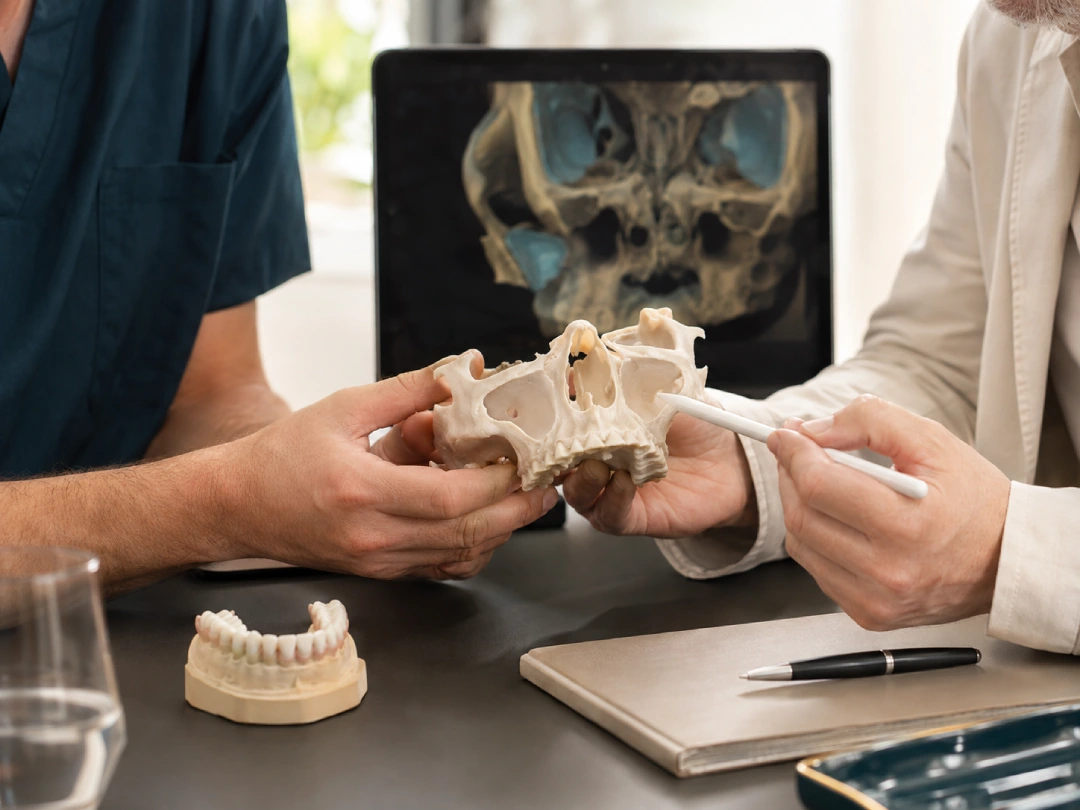
Illustrative image: implant position, sinus findings and surgical access must be assessed from the patient’s own clinical records and three-dimensional imaging.
ASSESSMENT & PLANNING
The sequence depends on existing teeth, bone distribution, sinus health, medical risk, surgical access, implant stability and the intended restoration.
Discuss previous implant or graft treatment, sinus symptoms, medical history, current teeth or denture and priorities.
The team assesses teeth, gums, bite, smile line, lip support, restorative space and the ability to clean a proposed prosthesis.
Three-dimensional imaging should include the maxilla, zygomatic bone and sinus region so anatomy and existing sinus pathology can be evaluated.
The intended teeth, implant distribution, abutments, materials, hygiene access and surgical pathway are coordinated before consent.
Surgery and any interim restoration follow the confirmed plan. Healing, function, sinus health, tissues and prosthetic components require ongoing review.
TREATMENT ALTERNATIVES
Severe bone loss can be managed through different surgical and prosthetic pathways. Existing maintainable teeth and less invasive options should be considered before committing to an advanced full-arch procedure.
May be possible where appropriate maxillary bone remains in positions that support the planned prosthesis.
Staged or simultaneous grafting may create implant options in selected cases, with its own healing, morbidity and timing considerations.
May provide an alternative foundation when severe maxillary deficiency limits conventional implant placement and the anatomy supports the approach.
A removable prosthesis, modification of the restorative goal or another reconstructive pathway may better fit some health, anatomy or maintenance needs.
Clinical note: The choice should reflect risks, benefits, prosthetic outcome, maintenance, treatment burden and patient preference — not travel speed alone.
CONFIGURATION FOLLOWS ANATOMY
The number and distribution of zygomatic and conventional implants are derived from available bone, the planned prosthesis and the consequences of a possible future complication.
One zygomatic implant may be considered on one side and splinted with other implants in selected anatomical situations.
Zygomatic implants may be placed on both sides and combined with suitable conventional anterior implants.
Two zygomatic implants on each side may be considered when conventional implant positions are not available in posterior or anterior maxillary regions.
Resection, trauma or congenital defects require additional surveillance, tissue and reconstructive considerations.
POTENTIAL PLANNING VALUE
RISKS & LONG-TERM CARE
BEFORE SURGERY
Advanced upper-jaw surgery should not be scheduled from photographs alone. The team must confirm the anatomy, health factors, prosthetic design, informed consent and a realistic aftercare route.
Assess existing sinus pathology, maxillary and zygomatic bone, the orbit and other neighbouring anatomy.
Confirm conditions, medicines, smoking and factors that may alter anaesthesia, surgery or healing.
Assess maintainable teeth, infection, gum and soft-tissue conditions and whether extraction timing changes risk.
Confirm restorative space, lip support, speech, bite, material, cleaning access and maintenance expectations.
Discuss alternatives, foreseeable complications, interim limitations, urgent-contact instructions and local follow-up needs.
REAL ZYGOMATIC IMPLANT RESULTS
Show consented Dr. Smile Antalya cases only after the starting anatomy, implant configuration, graft history, interim and definitive prostheses, complications and maintenance plan have been clinically verified.

Individual results vary. Images must have documented patient consent, and treatment descriptions must be clinically verified before publication.
INTERNATIONAL PATIENT SEQUENCE
Photographs and existing scans can organise an initial conversation. They cannot confirm candidacy, sinus health, implant configuration, anaesthesia, immediate loading or the final schedule.
Share treatment history and receive secure guidance on relevant records; do not send sensitive health information through the enquiry form.
Clinical examination and mid-face imaging confirm sinus findings, anatomy, alternatives and whether the proposed pathway can proceed.
Surgery follows informed consent. An immediate or early interim fixed prosthesis is used only when surgical and restorative criteria are met.
The team coordinates healing checks, definitive prosthetic stages, hygiene, sinus monitoring and local follow-up where required.
FREQUENTLY ASKED QUESTIONS
These answers are general information. A specialist team must explain what applies to your anatomy, sinus health and restorative plan.
They are specialised implants anchored in the zygomatic bone as part of an upper-jaw implant-supported restoration when severe maxillary bone deficiency limits conventional implant sites.
This is complex treatment that requires appropriate surgical and restorative expertise. Patients should ask about team credentials, planning responsibilities and how complications are managed.
Common indications include severe maxillary atrophy or deficiency, failed previous graft or implant treatment and selected maxillofacial defects. Individual three-dimensional assessment is essential.
No universal promise can be made. They may avoid a separate staged grafting pathway in selected cases, but anatomy or other reconstructive needs may still change the plan.
Yes. Mid-face CT or CBCT should assess the maxillary and zygomatic bone and sinus health. Existing sinus disease may require further evaluation or treatment.
Not automatically. An immediate or early interim prosthesis depends on implant stability, surgical findings, restorative design and the team’s loading criteria.
Recognised risks include sinusitis, infection, soft-tissue problems, oro-antral communication, altered sensation, implant or prosthetic complications and rare injury to neighbouring anatomy.
It describes two zygomatic implants on each side, considered when conventional implant positions are unavailable in both posterior and anterior maxillary regions. It is not required for every patient.
There is no fixed travel or treatment duration. Existing infection, sinus care, implant stability, healing, interim restoration and laboratory stages all affect the sequence.
Daily cleaning around and beneath the prosthesis, scheduled professional care, prosthetic reviews and prompt assessment of sinus, facial or implant symptoms are important.
ASK ABOUT ZYGOMATIC IMPLANTS
Tell us about your current upper teeth or denture, previous implant or graft treatment and priorities. Our patient coordination team will explain which records may be useful for an initial review.
WhatsApp: +90 545 213 09 59
Clinic: +90 545 213 09 09
Email: info@drsmileantalya.com
Fields marked as required must be completed.